Two new preprints: object-centric rewards and evolving scene graphs
August 4, 2026
Two new preprints are out
Object-centric graphs are a compact, interpretable way to represent
what is happening in a scene, and that representation can directly
power downstream robotics and reasoning tasks.
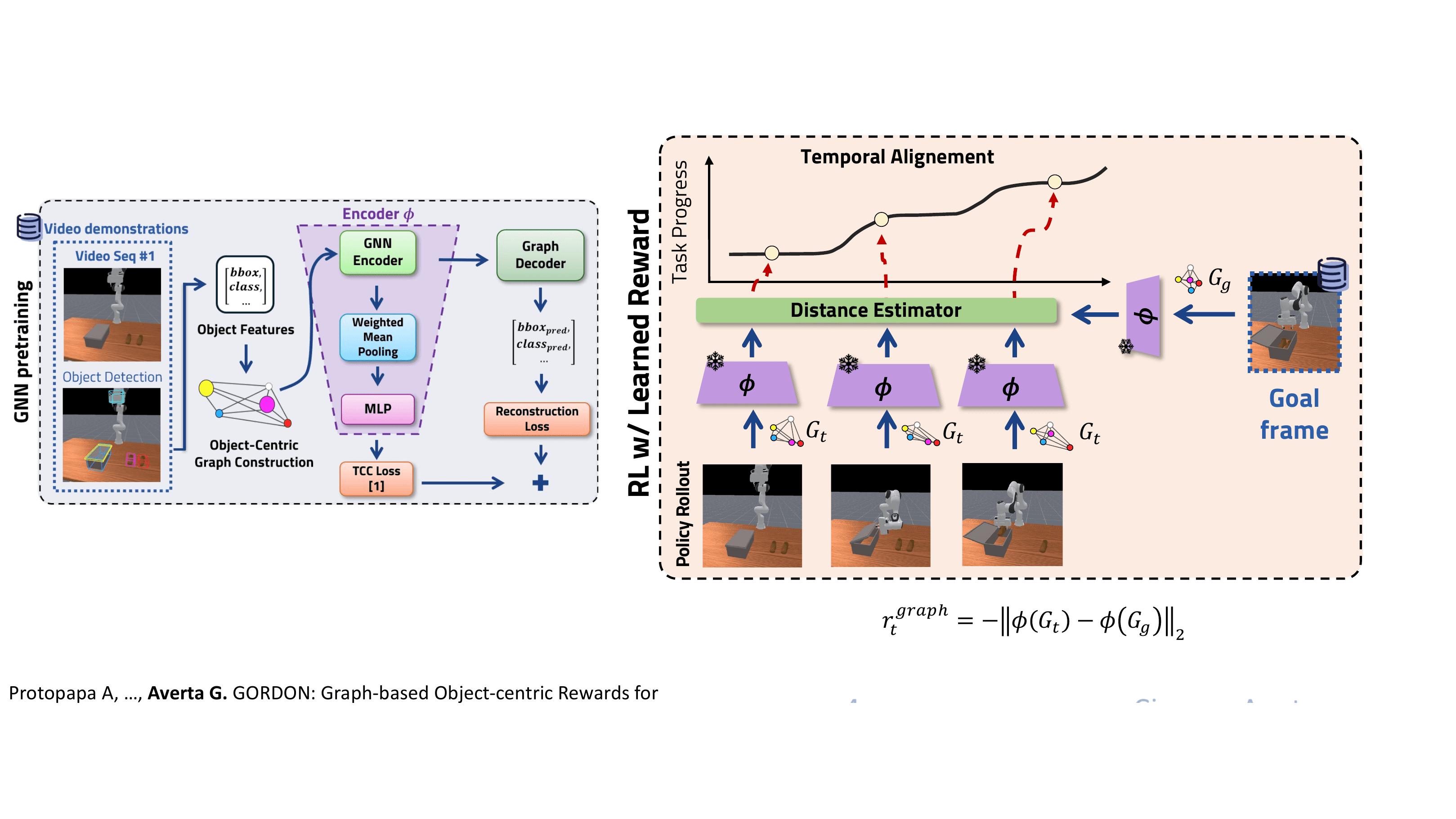
GORDON: graph-based rewards for long-horizon manipulation
Designing dense rewards for long-horizon manipulation by hand is hard, and video demonstrations are easy to collect but
hard to turn into a reward signal. GORDON (Graph-based Object-centric Rewards for DecompositiON) learns task
progress directly from action-free videos: an encoder is pretrained on object-centric graphs extracted from the
demonstrations, then frozen and used to compute a reward as the latent distance to a goal graph. Because the reward is
grounded in object relations rather than raw pixels, it naturally exposes the stage-wise structure of a long task,
enabling automatic subtask discovery and consistently outperforming pixel-based baselines on both short- and
long-horizon manipulation benchmarks.
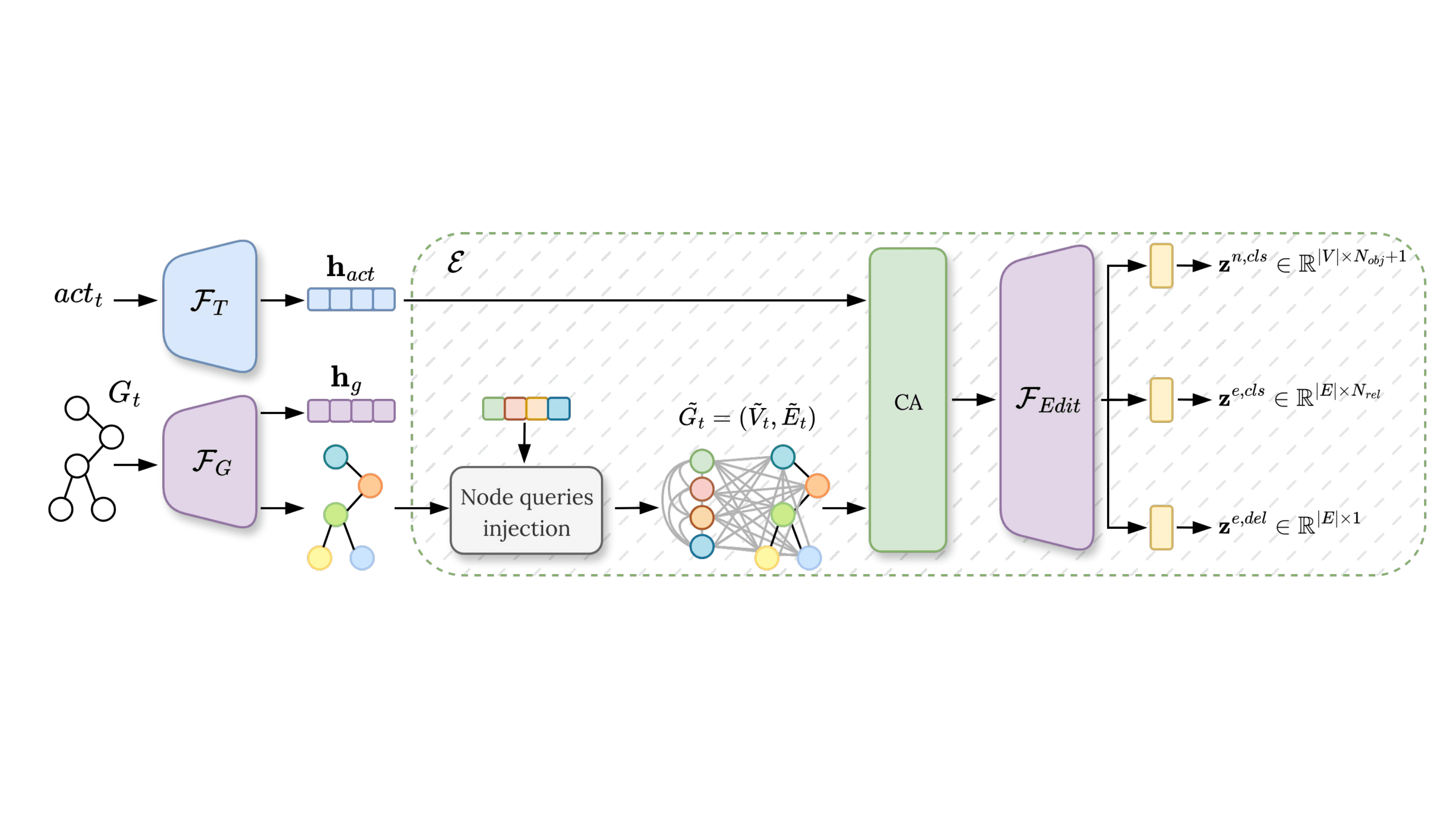
GLEN: learning to evolve scenes with scene graphs
Every human activity changes the environment, and scene graphs make those changes explicit. GLEN tackles
Activity-Conditioned Graph Edit Forecasting: given a scene graph and a textual description of an activity, it
predicts the sequence of node and edge edits (additions, deletions, updates) that transform the scene as the activity
unfolds. A graph encoder and a text encoder map graphs and activities into an aligned embedding space, and a graph
edit model predicts the resulting transformation. This turns scene graphs into a common language for long-horizon
reasoning, scene evolution and compositional video retrieval — before GLEN, this kind of long-horizon reasoning
over objects and relations was solved only by large multimodal LLMs.