





Turin, Italy
Projects

Human-Inspired robot learning

Human-Inspired robot learning
January 3, 2026
Humans are remarkably skilled at manipulating objects, adapting their movements to the task, the context and the objects at hand with little apparent effort. Our research starts from the conviction that, for robots to operate alongside people and act in a way that feels natural and predictable, they should be designed and trained by taking inspiration from the principles that govern human motor control. We study how humans plan, control and coordinate their movements, and translate these insights into planning, control and learning guidelines for robots. This spans the analysis of human manipulation and motor synergies, the design of human-like motion and grasping strategies, and the development of data-efficient learning methods that let robots acquire manipulation skills from a handful of demonstrations rather than from massive task-specific datasets.
IEEE IROS26
GAP: Geometric Anchor Pre-training for Data-Efficient Visuomotor Learning of Manipulation TasksDistils visual observations into stable geometric anchors, so a frozen vision foundation model learns new manipulation tasks from about a dozen demonstrations.
Under review
GORDON: Graph-based Object-centric Rewards for Decomposition of Long-Horizon ManipulationLearns dense rewards for long-horizon manipulation from action-free videos, using object-centric graphs to track task progress and discover subtasks automatically.
IEEE/RSJ IROS23
Domain Randomization for Robust, Affordable and Effective Closed-loop Control of Soft RobotsDomain randomization makes closed-loop control of soft robots robust and effective, narrowing the gap between simulation and the real world.
IEEE RA-L
A deep neural architecture for few-shot learning of novel human-inspired grasp strategies from RGB dataLearns new human-inspired grasp strategies from only a few examples.
IEEE ICRA20
A technical framework for human-like motion generation with autonomous anthropomorphic redundant manipulatorsA framework that makes anthropomorphic robot arms move in a human-like way, so their motions look natural and predictable to people.
IEEE RA-L
Learning from humans how to grasp: a data-driven architecture for autonomous grasping with an anthropomorphic soft handA data-driven architecture that learns from human demonstrations how to grasp objects autonomously with an anthropomorphic soft hand.
A recurring theme in our work is that compact, structured representations inspired by human motor behaviour make robot learning far more efficient and robust. By distilling visual observations into stable geometric anchors, we show that a frozen vision foundation model can be adapted to new manipulation tasks from as few as a dozen demonstrations, while remaining resilient to scene perturbations and domain shift. In parallel, we demonstrated that off-the-shelf vision-language models can support high-level robot planning without any task-specific training, drastically reducing the amount of data needed to deploy a robot in a new environment. Together with our earlier results on synergy-based grasping and human-like motion planning, these findings point towards robots that learn the way humans do — reusing prior knowledge and a small number of examples instead of brute-force data collection.
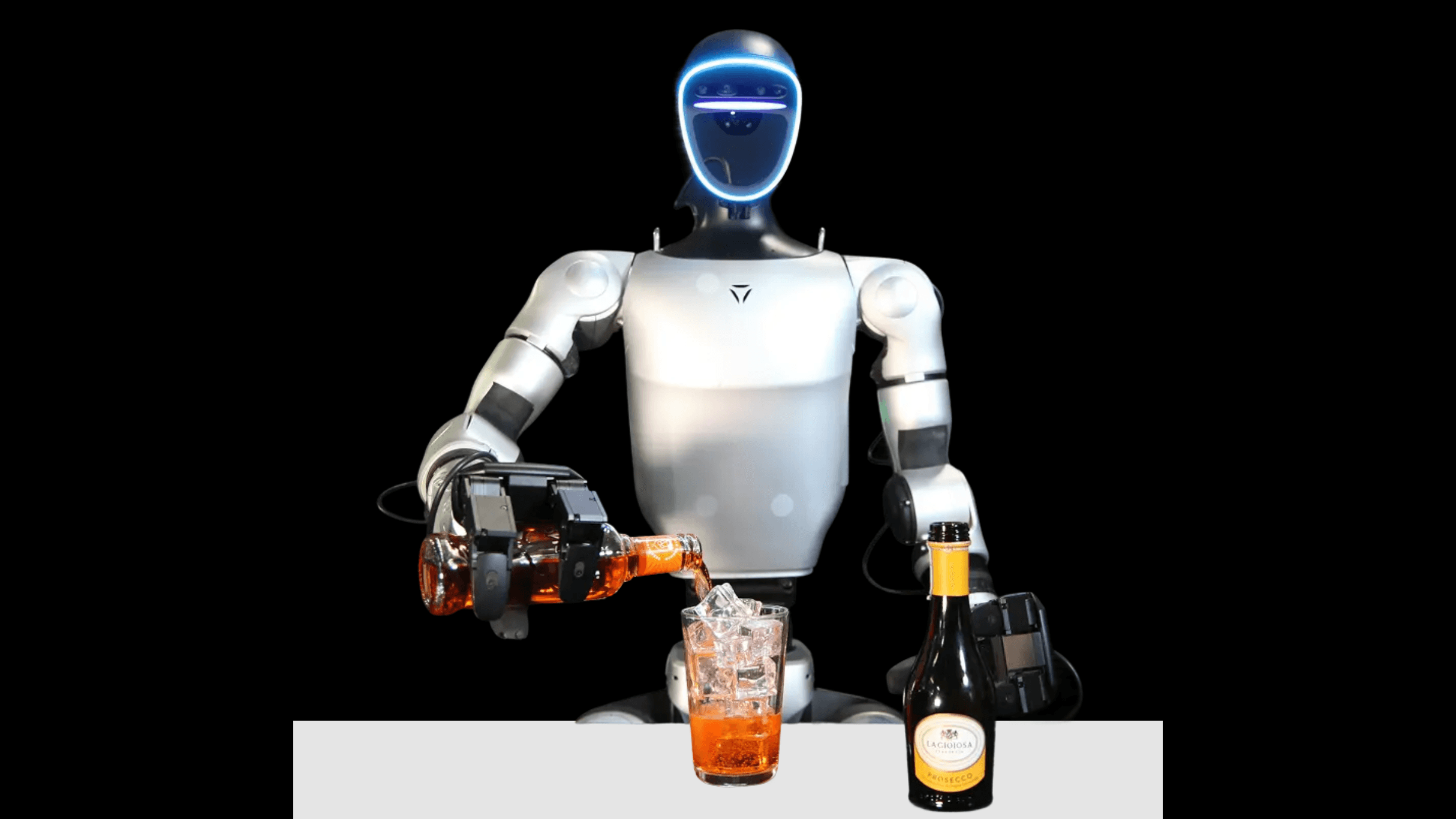
These ideas are being put to the test in Robi, an industrial collaboration in which we develop a humanoid robot able to perform complex, dexterous manipulation tasks — such as preparing and serving cocktails — in a real operational setting. Robi is a great playground for our human-inspired approach: it requires fluid, human-like coordination, robust perception, and the ability to learn and adapt skills efficiently, all while operating safely in an environment shared with people.
Working on human-inspired manipulation, and on a real platform like Robi, has taught us that the gap between simulation and the real world remains one of the hardest challenges: contacts, friction and the variability of real objects are difficult to model, and policies that work in the lab can be brittle once deployed. We have learned that data efficiency and robustness, rather than raw accuracy on a single benchmark, are the properties that matter most for robots acting in the wild. Designing inductive biases inspired by human motor control — structured representations, reusable skills, and human-like coordination — consistently helps us obtain behaviours that are more sample-efficient, more interpretable, and more reliable when the robot leaves the controlled environment.
IEEE IROS26Buoso, D., Protopapa, A., Di Carlo, S., Pistilli, F., Averta, G.
(Under Review)Protopapa, A., Buoso, D., Pistilli, F., Chalvatzaki, G., Averta, G.
IEEE T-SMCMarcello, L., Napolitano, O., Bonifati, P., Averta, G., Bianchi, M., Salaris, P.
IJCARSMuratore, L., Pescio, M., Barontini, F., Marzola, F., Leoncini, P., Ammirati, C.A., Arezzo, A., Dagnino, G., Averta, G.
A TaskGraspNet: A Large Scale Benchmark For Task-Oriented Grasping
(Under Review)Robbiano, L., Falco, G.S., Pistilli, F., Averta, G.
RF-DROPO: Data-Efficient Adaptive Domain Randomization for Zero-Shot Sim-to-Real Transfer of Soft Robot Control Policies
(Under Review)Protopapa, A., Tiboni, G., Vandaele, J., Tommasi, T., Camoriano, R., Duriez, C., Averta, G.
IEEE RA-LBuoso, D., Robinson, L., Averta, G., Torr, P., Franzmeyer, T., De Martini, D.
Elsevier Control Eng. PracticeBaracca, M., Averta, G., Bianchi, M.
IEEE/RSJ IROS23Tiboni, G., Protopapa, A., Tommasi, T., Averta, G.
HFR22Tiboni, G., Arndt, K., Averta, G., Kyrki, V., Tommasi, T.
IEEE RA-LArapi, V., Della Santina, C., Averta, G., Bicchi, A., Bianchi, M.
I-RIM 3D21Baracca, M., Bonifati, P., Nisticò, Y., Catrambone, V., Valenza, G., Bicchi, A., Averta, G., Bianchi, M.
Wiley Advanced Intelligent SystemsAverta, G., Barontini, F., Valdambrini, I., Cheli, P., Bacciu, D., Bianchi, M.
Frontiers in Robotics and AIAverta, G., Della Santina, C., Ficuciello, F., Roa, M.A., Bianchi, M.
Advanced Intelligent SystemsCenceschi, L.*, Della Santina, C.*, Averta, G., Garabini, M., Fu, Q., Santello, M., Bianchi, M., Bicchi, A.
"AI for Emerging Verticals: Human-Robot Computing, Sensing and Networking" — IETArapi, V., Zhang, Y., Averta, G., Della Santina, C., Bianchi, M.
IEEE RoboSoft20Arapi, V., Zhang, Y., Averta, G., Catalano, M.G., Rus, D., Della Santina, C., Bianchi, M.
IEEE ICRA20Averta, G., Caporale, D., Della Santina, C., Bicchi, A., Bianchi, M.
HFR20Averta, G., Arapi, V., Bicchi, A., Della Santina, C., Bianchi, M.
Journal of NeuroEngineering and RehabilitationAverta, G., Della Santina, C., Valenza, G., Bianchi, M., Bicchi, A.
I-RIM 3D19Averta, G., Bicchi, A., Bianchi, M.
I-RIM 3D19Della Santina, C., Averta, G., Arapi, V., Settimi, A., Bacciu, D., Catalano, M.G., Bicchi, A., Bianchi, M.
IEEE RA-LDella Santina, C., Arapi, V., Averta, G., Damiani, F., Fiore, G., Settimi, A., Catalano, M.G., Bacciu, D., Bicchi, A., Bianchi, M.
ICNR18Averta, G., Angelini, F., Bicchi, A., Valenza, G., Bianchi, M.
ICNR18Averta, G., Battaglia, E., Della Santina, C., Catalano, M.G., Bianchi, M.
IEEE RA-LAverta, G., Angelini, F., Bonilla, M., Bianchi, M., Bicchi, A.
IEEE RA-LGasparri, G.M., Manara, S., Caporale, D., Averta, G., Bonilla, M., Marino, H., et al., Garabini, M.
ICUMT17 — Best Student Paper Award, Best Paper in Session RoboticsAverta, G., Della Santina, C., Battaglia, E., Ciotti, S., et al., Bianchi, M.
IEEE ICRA17Bianchi, M., Averta, G., Battaglia, E., Rosales, C., et al., Bicchi, A.
IEEE ICRA17Casini, S., Tincani, V., Averta, G., Poggiani, M., Della Santina, C., Battaglia, E., et al., Bicchi, A.
IEEE Trans. Human-Machine SystemsAverta, G., Iuculano, M., Salaris, P., Bianchi, M.
Scientific ReportsKanzler, C.M.*, Averta, G.*, Schwarz, A., Held, J.P.O., Gassert, R., Bicchi, A., Santello, M., Lambercy, O., Bianchi, M.
Journal of Neural EngineeringCatrambone, V., Averta, G., Bianchi, M., Valenza, G.
ICNR20Baracca, M., Bonifati, P., Nisticò, Y., Catrambone, V., Valenza, G., Bicchi, A., Averta, G., Bianchi, M.
IEEE EMBC20Averta, G., Abbinante, M., Orsini, P., Felici, F., Lippi, P., Bicchi, A., Catalano, M.G., Bianchi, M.
"Advances in Motor Neuroprostheses" — Springer SeriesAverta, G., Bettelani, G.C., Della Santina, C., Bianchi, M.
IEEE EMBC19Schwarz, A., Averta, G., Veerbeek, J.M., Luft, A., Held, J.P., Valenza, G., Bicchi, A., Bianchi, M.
IEEE Trans. Neural Systems and Rehabilitation EngineeringAverta, G., Valenza, G., Catrambone, V., Barontini, F., Scilingo, E.P., Bicchi, A., Bianchi, M.
IEEE EMBC18Catrambone, V., Greco, A., Averta, G., Bianchi, M., Vanello, N., Bicchi, A., Valenza, G., Scilingo, E.P.
IEEE EMBC18Catrambone, V., Greco, A., Averta, G., Bianchi, M., Bicchi, A., Scilingo, E.P., Valenza, G.
IEEE Trans. Neural Systems and Rehabilitation EngineeringCatrambone, V., Greco, A., Averta, G., Bianchi, M., Valenza, G., Scilingo, E.P.
Frontiers in neuroroboticsDella Santina, C., Bianchi, M., Averta, G., Ciotti, S., et al., Bicchi, A.
Frontiers in Robotics and AIAverta, G., Della Santina, C., Battaglia, E., Felici, F., Bianchi, M., Bicchi, A.